
What is Bullet Resistant Glass and Why it Matters in Public Security

Updated: Jul 21, 2025

In today's world, safer public environments is becoming a top priority for architects, property owners, and facility managers. From schools and businesses to banks and government offices, there's a growing need to integrate materials that provide real protection. One of those materials is bullet resistant glass.
So, What is Bullet Resistant Glass?
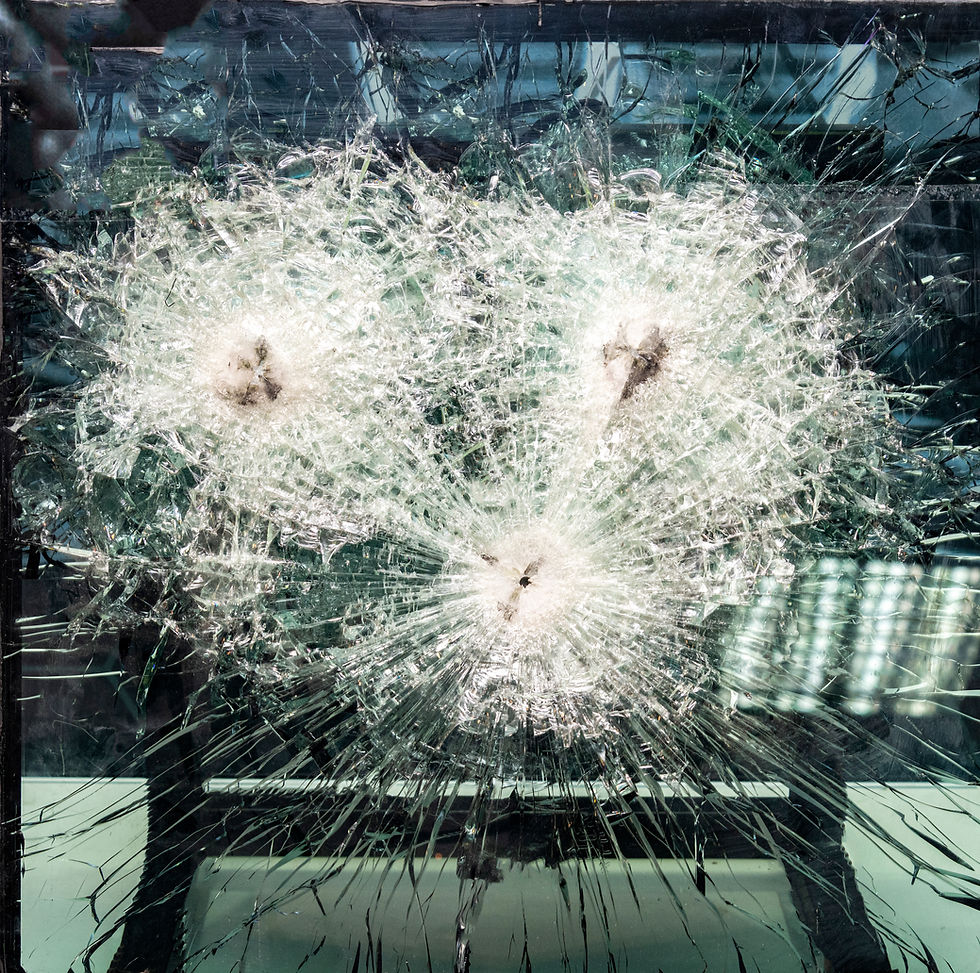
Unlike traditional glass, bullet resistant glass is specifically engineered to withstand ballistic impact by absorbing and dispersing the energy of a bullet amongst the glass. It's commonly made by using glass and polycarbonate, which is laminated to specific ballistic ratings. While it isn't truly "bulletproof", it dramatically slows down or stops projectiles, reducing the risk of injury.
A Rising Need for Smarter Security
According to the Pew Research Center, the U.S. experienced over 46,000 gun-related deaths in 2023, including nearly 18,000 homicides. While the overall rate of violent crime has fluctuated, public incidents involving firearms, particularly in retail spaces, schools, and transit areas have drawn national attention. As safety conversations continue, more businesses and institutions are looking into preventive security upgrades, including ballistic-related building materials.
But installing bullet resistant glass isn't about fear, it's about taking preventive steps to protect staff, customers, and the community. Think of it the same way we approach fire safety: you may never need to use a fire extinguisher, but it should still be there.
Understanding Bullet Resistant Glass
Bullet resistant glass might look like ordinary glass at first, but beneath the surface it's actually a carefully engineered system designed to protect against one of the most unpredictable threats: ballistic impact.
What It's Made Of
While every manufacturer has their own unique process, bullet resistant glass is typically made by laminating multiple layers of glass and plastic (usually polycarbonate). These layers are fused together under heat and pressure which creates a transparent barrier that resists bullets.
The outer layers provide hardness to shatter or slow down the projectile.
Inner layers absorb and distribute the energy.
The result: the bullet may crack or penetrate the initial outer layer, but it doesn't pass through the inner layer.
This minimizes spall, which are the dangerous shards that go flying with regular glass.
Understanding Ratings
Bullet resistant glass comes in different protection levels, usually based on standards like UL 752 (Underwriters Laboratories) or NIJ (National Institute of Justice). These levels indicate what type of firearm and ammunition the glass is able to resist.
Level 1: Protection against small handguns (.22, 9mm)
Level 3: Withstands larger handguns like .44 magnum
Level 7-8: Tested against rifles like 7.62mm rounds
The higher the level, the thicker and heavier the glass tends to be. But even entry-level protection can make the difference between life or death in real-world scenarios.
Where It Makes a Difference
Banks and financial institutions
Schools and universities
Retail stores and pharmacies
Government buildings and courthouses
Transportation hubs
Crime Rates in Urban Areas
While many U.S cities have seen declines in violent crime since the pandemic, gun violence remains a persisting problem.
Improvements, but not a uniform trend
According to the Major Cities Chiefs Association (MCCA), the first quarter of 2025 saw a 21% decrease in homicides and a 14% decrease in violent crime compared to Q1 of 2024.
Additional reports confirm violent crime was down 14%, murder/robbery was down by 21%, and shootings were down by 27% in those cities.
Nationwide, cities like Chicago saw homicide and shooting rates trend downward in 2024 and 2025 compared to its 25 year high in 2021.
However, not every city fits the trend. Unlike many other major cities, Houston, Texas had an increase in homicides from 104 in Q1 2024 to 112 in Q1 2025.
Gun Violence Remains a Serious Reality
According to the Gun Violence Archive, as of mid-year 2025, there has been about 8,000 gun-related deaths, 14,000 injuries, and 222 mass shootings.
Nearly 200 people were killed and 877 wounded in 204 mass shooting incidents through June 30, 2025.
Conclusion: Preparedness Gives Peace of Mind
Despite recent declines in violent crimes across many U.S cities, the need for safety measures hasn't disappeared. By investing in bullet resistant glass, you are 2 steps ahead in a world where risk and crime can shift from city to city, day by day.
Here at Brick Glass, we've spent the past year engineering bullet resistant glass that meets the highest industry standards. We are proud to say that we are now UL 752 certified in the levels 1, 3, 5, and 8.
Level 1: Able to resist various handgun threats including .9mm handguns
Level 3: Withstands continuous fire from a handgun
Level 5: Designed to withstand rifle attacks from .308 caliber rifles
Level 8: Maximum defense against sustained fire from .308 caliber rounds
UL 752, developed by Underwriters Laboratories is the leading standard for bullet resistant glass in the U.S. This certification requires strict testing including the hot and cold test. These hot and cold tests mean the glass is able to stay intact when shot in temperatures of 120°F, and -20°F, as well as it's performance against different shot patterns like the triangle test and the two-shot test.
While we are not currently actively selling bullet resistant glass, we are fully certified and preparing for its market release very soon.
Comments